
Teeth Braces Cost in India – What Should You Expect at Bishnoi Dental Clinic?
March 18, 2026
Why Regular Dental Checkups Matter?
July 5, 2026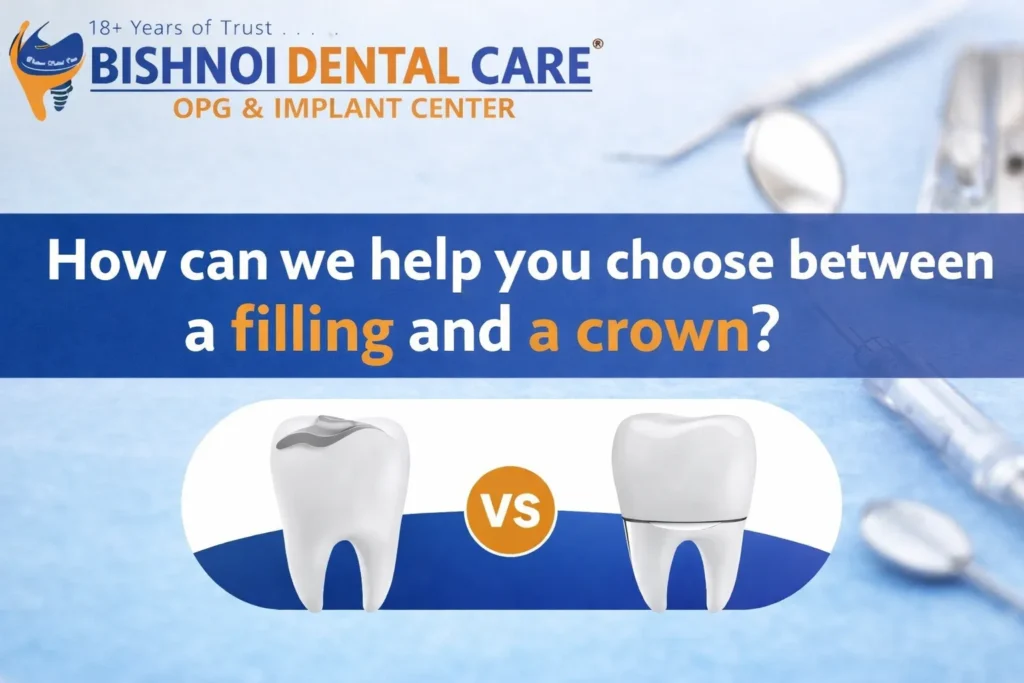
Most people walk into a clinic thinking, “It’s just a cavity, I’ll get a filling and be done.”
That assumption is where things start going wrong.
Not every damaged tooth can be fixed with a filling. And choosing the wrong treatment doesn’t just delay the problem, it makes it worse.
This guide is here to help you understand one simple thing:
When is a filling enough, and when do you actually need a crown?
If you’re unsure about your situation, getting a proper evaluation at a trusted Dental Clinic in Udaipur can save you from unnecessary treatments later.
What is a dental filling, and when is it enough?
A dental filling is used to repair a tooth affected by decay.
Here’s how it works:
- The dentist removes the decayed part
- The empty space is filled with a material
- The tooth is restored to normal function
A filling is enough when:
- The cavity is small or moderate
- Most of the tooth structure is still strong
- There are no cracks or structural weakness
It’s quick, cost-effective, and works well when the damage is limited.
But here’s the key point most people ignore:
Fillings are not designed to handle major damage.
What is a dental crown and why is it needed?
A crown is a full cover placed over your tooth.
Instead of filling a part of the tooth, it:
- Covers the entire structure
- Restores strength and shape
- Protects the tooth from further damage
A crown is used when:
- The tooth is weak
- A large portion is damaged
- The structure can’t support a filling
Think of it like this:
A filling repairs. A crown protects and reinforces.
Filling vs Crown: What’s the real difference?
Let’s make this simple and clear.
Filling:
- Covers only the damaged area
- Suitable for small decay
- Less expensive
- Shorter lifespan
Crown:
- Covers the entire tooth
- Used for major damage
- Stronger and more durable
- Long-term solution
This is not about which is “better.”
It’s about which is appropriate for your condition.
When do you actually need a crown instead of a filling?
This is where most people make the wrong call.
You need a crown if:
- The cavity is large and affects most of the tooth
- The tooth is cracked or weakened
- You’ve had multiple fillings on the same tooth
- You’ve undergone a root canal
- The tooth is at risk of breaking under pressure
Let’s be direct here.
If your dentist recommends a crown in these situations and you still choose a filling to save money, you’re taking a risk.
And it usually backfires.
What happens if you choose a filling when a crown is needed?
This is not a “maybe” situation. The consequences are predictable.
- The tooth can crack or fracture
- Pain and sensitivity may increase
- The filling may fail quickly
- You may eventually need extraction
Now instead of a controlled treatment, you’re dealing with damage control.
And yes, it becomes more expensive and complicated.
Cost vs value: is a crown really worth it?
A lot of patients hesitate because crowns cost more.
That’s understandable. But let’s look at this logically.
Filling:
- Lower upfront cost
- May need replacement or fail if misused
Crown:
- Higher upfront cost
- Long-term protection
- Reduces risk of future treatments
So the real question is not cost.
It’s value over time.
Pay less now and risk bigger expenses later, or invest once and protect your tooth properly.
How long do fillings and crowns last?
Let’s keep expectations realistic.
- Fillings: typically 5–10 years
- Crowns: often 10–15+ years
But here’s the truth.
Longevity depends more on your habits than the material.
If you:
- Ignore oral hygiene
- Bite hard objects
- Skip dental visits
Even the best treatment won’t last.
How to take care after a filling or crown?
Post-treatment care is simple, but most people get lazy.
Do this consistently:
- Avoid very hard or sticky foods initially
- Brush twice daily
- Floss regularly
- Visit your dentist for check-ups
Small habits make a big difference in how long your treatment lasts.
How do you know what’s right for your tooth?
You don’t decide this based on guesswork or internet advice.
Every tooth is different.
Every case is different.
What worked for someone else may not work for you.
The only reliable way to decide:
- Proper examination
- X-rays if needed
- Honest consultation
Anything else is just guessing.
FAQs
Is a crown always needed after a filling?
No. Only when the tooth is too weak or heavily damaged.
Can a filling be replaced with a crown later?
Yes, and it often happens when fillings fail.
Does getting a crown hurt?
No. The procedure is done under anesthesia and is comfortable.
Which lasts longer: filling or crown?
Crowns generally last longer due to better protection.
Is a crown better for back teeth?
Yes, especially for molars that handle heavy chewing pressure.
How much damage requires a crown?
If a large portion of the tooth is lost or weakened, a crown is usually recommended.
Final thoughts: don’t choose based on cost, choose based on condition
Here’s the honest takeaway.
A filling is great when the damage is small.
A crown is necessary when the tooth needs strength and protection.
The mistake is trying to force a cheaper solution on a bigger problem.
That decision doesn’t save money. It delays the damage.
If you want to protect your tooth long-term, make the right call early instead of fixing bigger problems later.